

July 13, 2026
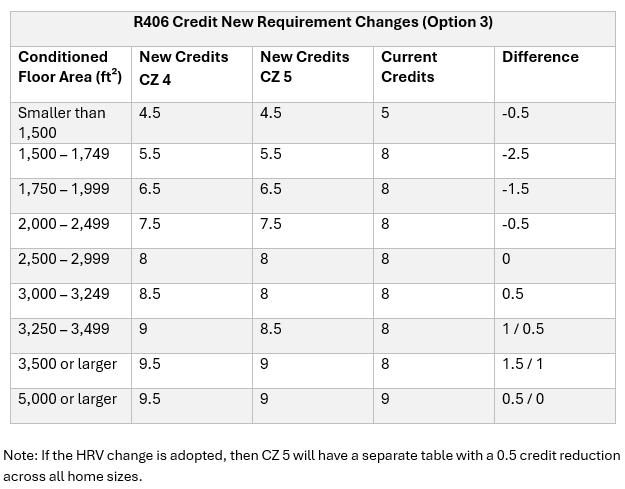
Correction: An earlier version referenced an older version of the proposed R406.2 credit requirements. The table has been updated to reflect the current proposed values.
Nothing is certain in life except death, taxes, and energy code updates—unless you live in a state like California that has decided to delay their energy code. Unfortunately, Washington hasn’t gone that route (yet… there’s still time WA lawmakers!) and the State Building Code Council (SBCC) is accepting public comments on their proposed changes for the 2024 energy code.
If you are willing to provide public testimony, please fill out the testimony sign-up form and send it to the SBCC before the hearing date. The SBCC is also accepting written comments at sbcc@des.wa.gov through Aug. 7.
We know everybody has been diligently reading through the hundreds of pages of changes… just kidding who wants to do that?! Because we like ranking things, and Western movies, here is a top five list—mixed with the good, the bad and the worst—of the major changes in the 2024 residential energy code!
Starting off, prepare yourself, because most builders aren’t used to hearing the words “great” and “energy code” in the same sentence unless it’s sarcastic.
THE GREAT
Energy Rating Index (ERI) Pathway | 24-RE-033/040 | (New) R408
- Recommendation: Adopt
- Amend: We supported a compromise of 10% to get the ERI moving along, but changing the thermal envelop backstop to match the model (IECC) code at 15% would provide greater flexibility for construction costs while still achieving energy efficiency for consumers.
- This merged proposal from BIAW and NEEA brings in the alternative ERI compliance pathway from the model code.
- Long requested by the industry, this is a type of performance pathway that is more flexible and produces a simple report and “score” that helps industry, building officials, and consumers understand the relative energy efficiency of a home.
- Industry Insight: Production builders and green builders frequently use ERI scores in their homes, so this should make compliance much easier to determine.
- Savings can come from things like solar gain where the home or building is oriented so it receives natural heating from windows. There is no equivalent option in the prescriptive pathway.
THE GOOD-ISH
New Dwelling Size Brackets | 24-RE-035 | R406.3
- Recommendation: Support changes for small medium dwelling units (under 2250 sq ft.)
- The original proposal increased credit requirements for medium and large dwelling units and added a new “very large dwelling unit” category. Revisions incorporated concepts from the BIAW proposal 24-RE-031 to remove size categories and instead have credit requirements be 0.5 credits per X sq ft of conditioned floor area.
- The current proposed version marries the two concepts in a surprise wedding that expands the size of the brackets for medium and large dwelling units into ten 250-sq-ft increments. It includes credit reductions for the lower end of the old medium category and increases starting around 2,500 sq ft. There are different options contingent on the SBCC adopting other provisions in the code. See table below for comparison to current code.
- What does this proposal help solve? Currently, 1,500 sq ft and under you only need 5 credits. Then a 1,600 sq ft home would be treated the same as one at 4,000 sq ft and both would need 8 credits. The expanded brackets help smooth out the costs and make it less expensive to build smaller homes.
- Industry insight: As we go up in credit requirements, the available options to choose from become more expensive. This change will help smaller dwelling units, but the cost for medium to large will go up. You’ll likely have to add solar to use gas for space and water heating, although this will become slightly more effective if you use the new battery storage credit option.
THE BAD-ISH
Component Performance Alternative Equation | MVPE Change | R402.1.5
- Recommendation: Don’t Adopt
- This change makes the component performance alternative equation more restrictive. It was originally supposed to be in the 2021 code, but due to some procedural stuff it was excluded from the final code. The change is not part of the model code.
- Industry insight: Many builders rely on the additional credits available by going above code, reducing the total conductive UA by 15-30%. This is relatively easy to figure out by using WSU’s infamous C3 calculator. Making the base equation more restrictive than the model code will make it harder and more expensive, if not impossible, to hit those additional credit options.
THE BAD
Heat/Energy Recovery Ventilator (H/ERV) for CZ 5 | 24-RE-038 | R403.6.1
- Recommendation: Don’t Adopt
- This new section requires heat or energy recovery ventilators (H/ERV) in climate zone 5 (the east side of the state). HRVs transfer heat from outgoing air to incoming fresh air, reducing the heating load on your space heating equipment.
- The SBCCs own cost-benefit analysis shows a net cost of -$888 per dwelling unit. To keep the payback under 50 years, they had to exclude replacement costs.
- Industry insight: HRVs without ducting need air handlers and adding mechanical for fully ducted increases costs even more. Because the state code pushes ductless mini-split heat pumps so hard, it makes it harder to use ducted space heating (especially natural gas) which doesn’t mesh well with requiring HRVs.
AND THE WORST
(The lack of) Energy Choice | R406.1
- Recommendation: Listen to the voters
- Sometimes the worst change is no change at all. That is the case with table R406.1. It goes by many names, carbon emission equalization, energy equalization, or fossil fuel normalization. Whatever you call it, its mission is simple: discourage and penalize natural gas furnaces. This effectively requires different efficiency targets for buildings based on what fuel type they are using. Electric heat pumps are effectively counted twice in the additional credit requirements, getting more than double the credits they otherwise should.
- The constitutionality of I-2066 is currently being decided by the State Supreme Court, but the SBCC can still listen to the will of the voters and make an energy code that lets consumers choose what energy they want to use based on reasonable efficiency requirements.
- Additionally, there are new changes to increase electric readiness or push for electric heat pumps to replace air conditioning units. These changes should not be adopted, and the SBCC should listen to Washingtonians and support energy choice.
There you have it, roll the credits (double pun intended). But wait! These are five of the biggest changes coming in the 2024 code, but there are more and we want to provide more info for those that want to dive deeper into the details. Check our website for more updates in the coming weeks!
Time and time again, we’ve proven you can reach energy efficiency or climate resiliency goals without adding unnecessary costs. It’s time to remind policy makers that updating the energy code doesn’t mean that we have to make housing more expensive.