February 23, 2026
The new February economic and revenue forecast projects a $1.86 billion increase in revenue for Washington state over the next four years compared to the previous forecast in November. This updated forecast determined how much revenue budget makers in Olympia could count on when crafting this year’s supplemental budget.
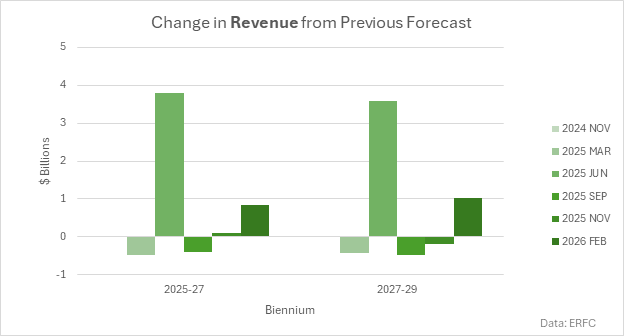
The growth in revenue projections comes from updated economic forecasts showing higher personal income, employment, slightly faster GDP growth, and lower inflation.
Last year, after passing the largest tax increase in state history, the June 2025 forecast showed a $7.4 billion increase in revenue over four years. Subsequent forecasts tempered these expectations with more moderate estimates of revenue growth. The new February 2026 forecast shows more revenue growth than the prior two forecasts.
Despite this rosier-than-expected revenue forecast, both House and Senate Democrats introduced budgets with more spending and less fiscal restraint over the weekend.
Housing Indicators
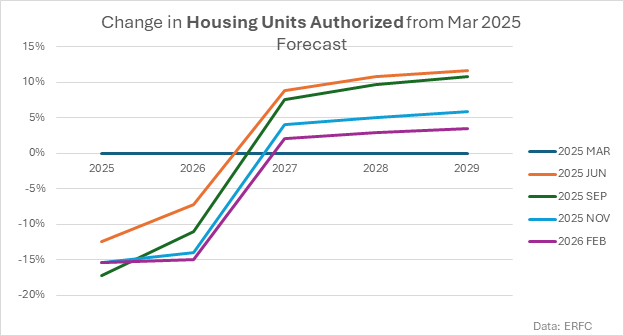
Housing projections are still lagging behind the March 2025 estimates that were used to determine the biennial budget last year. The February 2026 forecast estimates an average of 36,000 housing units authorized per year over the next four years. This is far below the more than 50,000 and per year that Commerce has calculated we need to address the housing crisis.
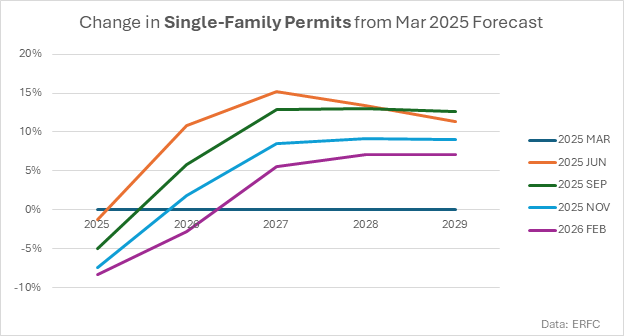
Single-family permits are projected to drop even more in 2025 and 2026 and then rebound to 5-7% greater than the March 2025 forecast. However, gains in single-family permits are being offset by reductions in multifamily.
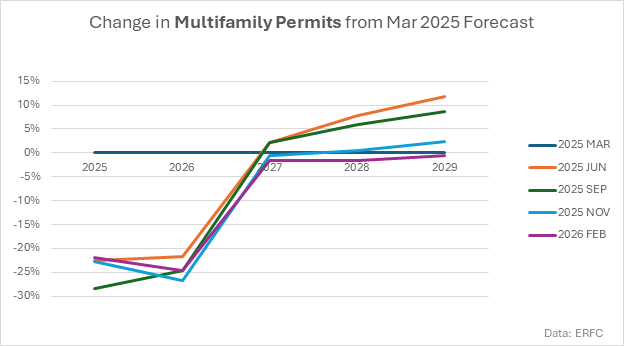
The forecast for multifamily permits has slightly improved in the short term from the November 2025 forecast. But this is still a 20-25% drop from initial estimates in March 2025. Even worse, multifamily is no longer projected to exceed initial estimates in 2029. This aligns with NAHB expectations for the national multifamily market to cool down in 2026, citing tighter financing and elevated construction costs as contributing factors. Additionally, statewide policies such as rent control directly increase financing risks and construction costs, disproportionately affecting multifamily construction.
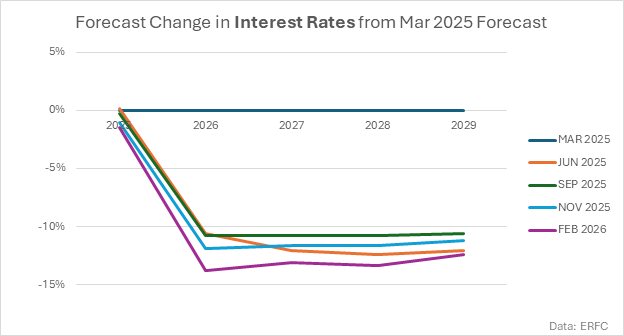
Revenue & Budget
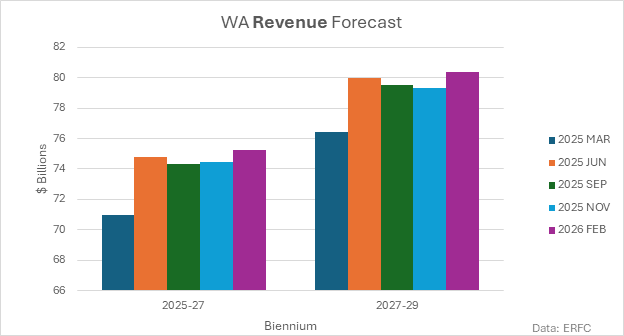
Looking at the overall picture, total revenue is now projected to exceed the highs from the June 2025 forecast. With $75.3 billion in the current 2025-27 biennium and $80.4 billion in the 2027-29. Despite massive tax increases and revenue growth, this does not mean a budget surplus. The legislature has also increased spending by expanding current prorams and creating new ones.
A recent legislative report, using the November 2025 forecast, projected a $4.3 billion deficit over the next four years when factoring in maintenance level spending. Using that estimate and extrapolating the February 2026 forecast showing $1.86 billion more revenue than the November 2025 forecast, the legislature is looking at approximately a $2.5 billion deficit over the four-year outlook. This does not factor in whether the legislature decides to increase spending further, which would expand the deficit.
The legislature also may be tempted to use the Budget Stabilization Account (rainy day fund) to fill some of the deficit, but that will place the state in a precarious situation if the economic outlook worsens and widens the deficit in future years. Which is quite possible considering the forecasts continue to project residential construction to decline this year. Instead, the legislature should look for ways to bolster the economy, decrease construction costs and reduce government costs and liabilities.
2026 Supplemental Budgets
Over the weekend the House and Senate released proposals for the 2026 supplemental budget. These budget proposals incorporate the slightly increased revenue forecast. With it, they pair some spending cuts which are offset by large spending increases at both the maintenance and policy level. To balance the budget, they assume the legislature will approve new taxes (including the income tax proposal) and other tax increases, along with transferring money out of the rainy-day fund.